Archive story
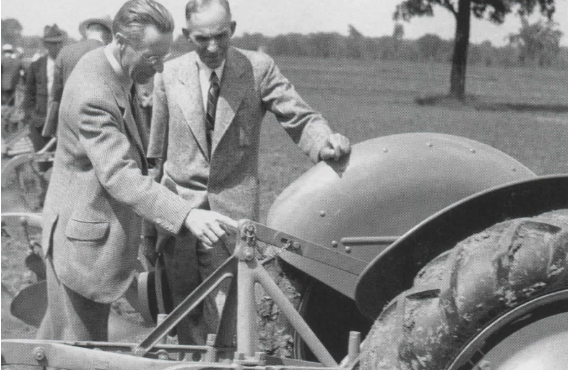
Dearborn, Michigan · October 1938
The Handshake Agreement — when Ferguson met Ford
In 1938, years of Ferguson System development met the manufacturing capacity that could carry it to farmers on a new scale.
Read storyStories from the archive
Read archive-led features about William Sands, engineering developments, important places and discoveries emerging from the collection.
Archive story
Dearborn, Michigan · October 1938
In 1938, years of Ferguson System development met the manufacturing capacity that could carry it to farmers on a new scale.
Read story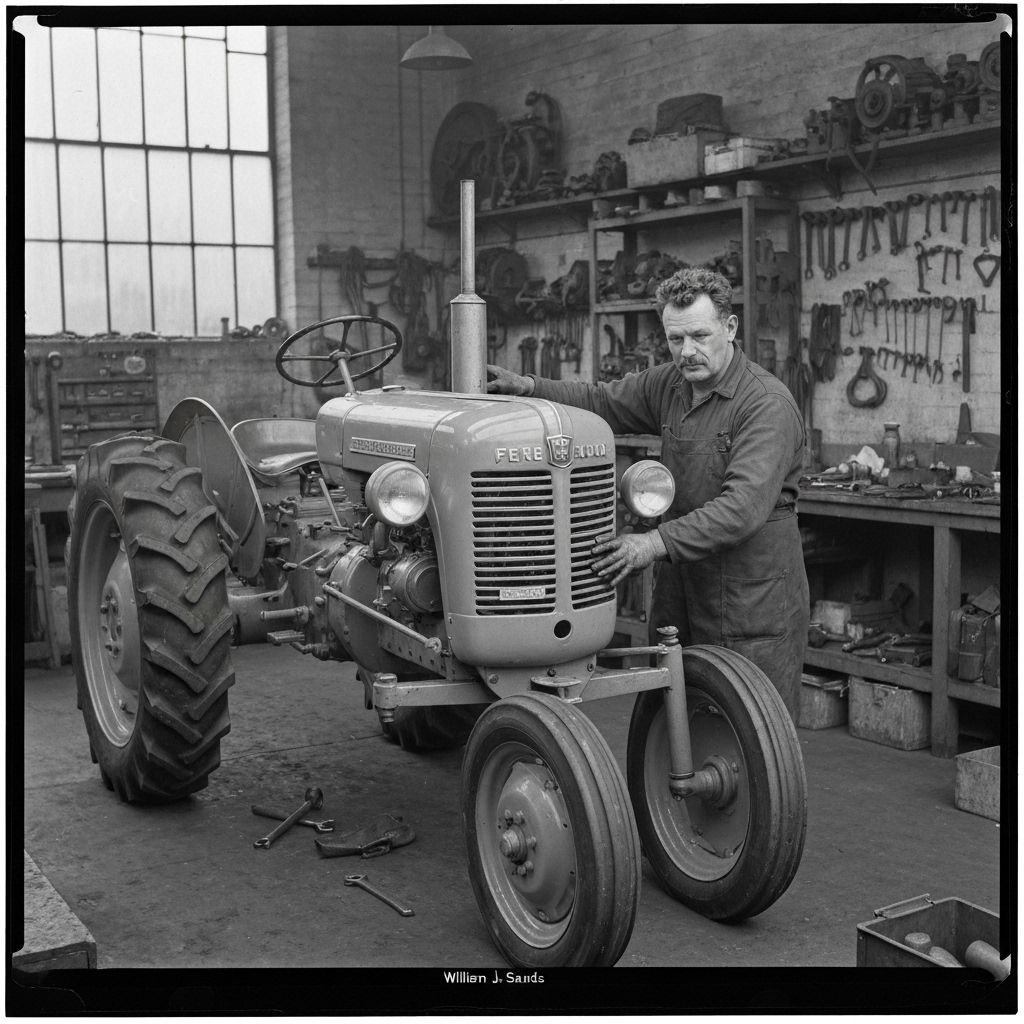
News Letter · 18 June 2025
A profile of William Sands’ engineering career, his long collaboration with Harry Ferguson, and the practical skill and problem solving that helped shape the Ferguson System and modern farm machinery.
By Stevan Patterson
William John Sands was born on June 18, 1891 at Kilsorrel, Dromore, County Down, Ireland. He followed his father Samuel into working in the linen industry as a mechanic, before going to work for Harry Ferguson in Belfast.
William Sands was a very gifted engineer and designer in his own right and is best remembered for being Harry Ferguson’s chief engineer, tester, researcher and problem solver. He is rightfully deserving of having a blue plaque in his honour, for which I have nominated him.
He achieved so much in helping to modernise agriculture along with Harry Ferguson, but sadly he is often overlooked and is a further example of a life story that the Harry Ferguson Museum of Innovation will address.
As a young man, William Sands was a keen motorcycle enthusiast who competed in motorcycle trials and races. This brought him to the attention of Harry Ferguson, who was also a motorcycle enthusiast. Harry saw Sands’ potential and employed him in 1911 as a mechanic and engineer when he established his first business at May Street Motors in Belfast.
Together they saw technology as a way to improve lives. As committed Unionists, both signed the Ulster Covenant on Ulster Day, September 28, 1912, against home rule in Ireland.
Ferguson came up with ideas and left the detail of joining the dots to Sands, who had a great ability to think logically, solve problems and engineer practical working solutions. Sands’ own inventions, recorded in patents, show that he was also a great innovator and achiever who could think beyond convention and develop new ideas and technologies.
As well as selling cars and motorcycles, Ferguson took on the dealership of tractors. One was called Overtime in the British Isles, a renamed Waterloo Boy tractor made in the USA. The Waterloo Boy Company was purchased by John Deere in 1918, bringing that company into the tractor business. Ferguson held the sole dealership rights in Ireland for the Overtime tractor.
During the Great War, German U-boats targeted ships carrying imports of grain in an attempt to starve the people of the British Isles into surrender. By early 1917, only about two additional weeks’ supply of food remained.
The Irish Board of Agriculture recruited Ferguson and Sands as part of UK-wide schemes to grow more food at home because of their expertise in tractors and ploughs. They began work at 5am on March 19, 1917, travelling in a supplied car in which they often slept and visiting tractor owners across the country. They showed farmers how to adjust and get the best from their tractors and ploughs, contributing greatly to the success of Ireland’s 1917 ploughing-up campaign.
Around 1916, it became clear to Ferguson and Sands that existing ploughs had major failings. Ferguson began designing his first plough with Sands’ assistance, and the first Ferguson plough went on sale in 1917.
Known as the Ferguson Belfast plough, it attached by a single link to the Eros, a popular tractor conversion of the Ford Model T. It was manufactured in Ferguson’s Belfast workshop by Sands and Archibald Greer, another apprentice and patent-making engineer. Sands improved the design to fit the new 1917 Fordson tractor built by Henry Ford in the USA. The original single-point linkage became the two-point, or Duplex, linkage by the end of 1919.
After an unsuccessful 1920 meeting between Henry Ford and Harry Ferguson, Ford declined to put the plough into production. Sands left to establish a successful motor repair and hire business, seeing little future in the plough without mass production.
Ferguson realised that he needed Sands. When a company in the USA agreed to mass-produce the plough in 1922, Sands returned. He understood the importance of what they were trying to achieve. Major advances followed rapidly, leading to Harry Ferguson’s 1925 invention of the modern tractor with quickly interchangeable implements. Sands played a crucial role in that invention.
A converging three-point hydraulic linkage followed. The first arrangement used two upper links and one lower link, but it suffered control problems. Sands suggested moving the single middle lower link to the top, establishing the familiar three-point linkage with one upper link and two lower links set to converge.
Sands played a major part in designing and building the world’s first Ferguson System tractor, the Ferguson Belfast Black prototype, built between 1931 and 1933 in Belfast and perfected by 1935 in the County Tyrone fields at Tullylagan owned by Thomas MacGregor Greer.
As Ferguson’s chief engineer, Sands was involved in designing and developing the first production Ferguson System tractor, the Ferguson-Brown Type A introduced in 1936, and the first mass-produced Ferguson System tractor, the Ford-Ferguson introduced in 1939. He also designed the dedicated implements essential to the Ferguson System of farm mechanisation.
Sands modified Ferguson-Brown Type A serial number 3, a prototype tractor, by hand-fabricating a new rear section from steel plate so a central power take-off could be fitted. He also cut away the rear of the first Ford-Ferguson to arrive in Northern Ireland, enabling Harry Ferguson to demonstrate how the Ferguson System worked in 1940.
While Harry Ferguson was in the USA, Sands and Archibald Greer designed implements in Northern Ireland during the early 1940s, including the Ferguson Belfast potato digger and Ferguson Belfast steerage cultivator, which were built at the Ferguson factory in Moira.
The long working relationship between William Sands and Harry Ferguson ended after the war when Ferguson tractor production moved to England. Sands no longer wanted to travel and preferred to remain in Northern Ireland.
In 1948, Harry Ferguson began a court case against the Ford Motor Company over its continued production of the Ford 8N tractor without Ferguson’s permission. Ford persuaded Sands to testify that the majority of the ideas leading to the Ferguson System were his. Ferguson regarded this as a betrayal by his former chief engineer and long-time friend. In 1952, Ferguson won a consent judgment; Ford agreed to pay 9.25 million dollars for patent infringements and to end production of the Ford 8N by the close of that year.
Ferguson and Sands met and reconciled later in the 1950s, putting their differences behind them and becoming friends again. Ferguson agreed to give Sands a generous pension and understood how much he owed to the engineering talent and technical knowledge that had helped turn his ideas into working machinery.
Harry Ferguson paid tribute to both Archibald Greer and William Sands, giving Sands particular credit and arguing that the two men deserved a high place in the future history of mechanised farming for their engineering skill, patience and cooperation during their trials.
William John Sands died in his sleep at his Belfast home on October 8, 1981. He was 90 years old and was buried in Lisburn Cemetery.
Article text supplied for this archive page and lightly edited to remove advertising and correct spacing.